A new mini excavator in the most popular size class will run you $30,000 to $60,000. Once you add in fuel, maintenance, insurance, and depreciation, your real operating cost is $25 to $60 per hour. Routine maintenance eats up $1,000 to $2,500 a year on most machines. Then there are the unplanned repairs. They can pile on several thousand more in a bad year. That gap between what you can predict and what you can’t is where most first-time buyer budgets fall apart.
A quick note on the numbers in this guide. All figures are typical industry ranges. Regional pricing, machine condition, brand, and individual usage all shift outcomes in either direction, so verify current pricing with local dealers before locking in a budget.
Mini Excavator Costs at a Glance
Owning a mini excavator involves three cost layers. The upfront purchase price ($15,000 to $80,000, depending on size and condition). Ongoing operating cost of roughly $25 to $60 per hour for fuel, maintenance, insurance, and depreciation combined. And periodic large repairs that can run from a few hundred dollars for a hose to several thousand for a hydraulic pump or undercarriage rebuild. Across a 5-year ownership period, the total cost of ownership typically lands at 1.5 to 2 times the original purchase price.
| Cost Category | Typical Range |
| Purchase price (new, 1 to 5 ton) | $25,000 to $80,000 |
| Purchase price (used, 1 to 5 ton) | $10,000 to $50,000 |
| Fuel | $4 to $12 per operating hour |
| Routine maintenance | $1,000 to $2,500 per year |
| Insurance | 1% to 3% of the machine value annually |
| Combined operating cost | $25 to $60 per hour |
| Service life with proper care | 8,000 to 12,000 hours |
What Is a Mini Excavator?
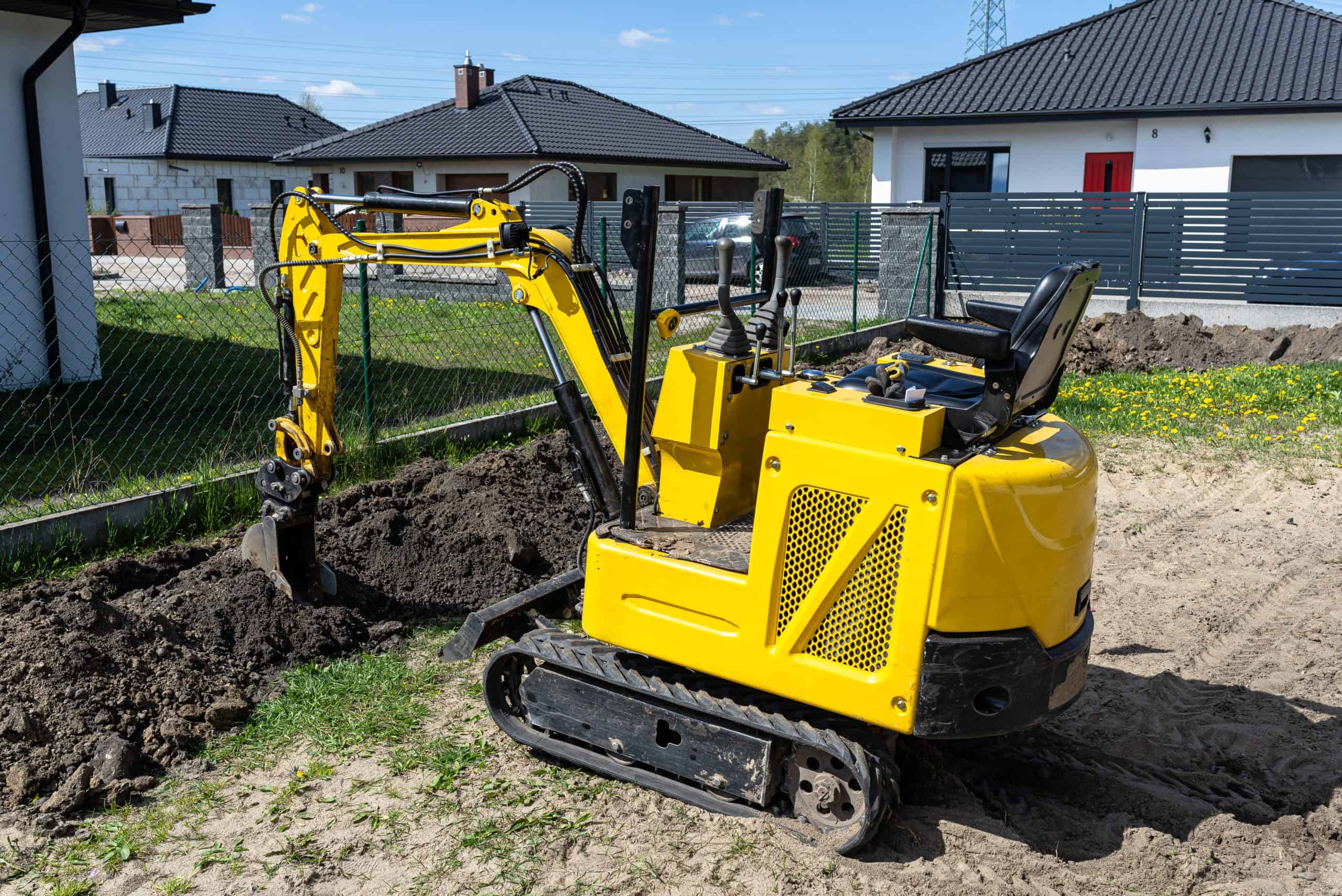
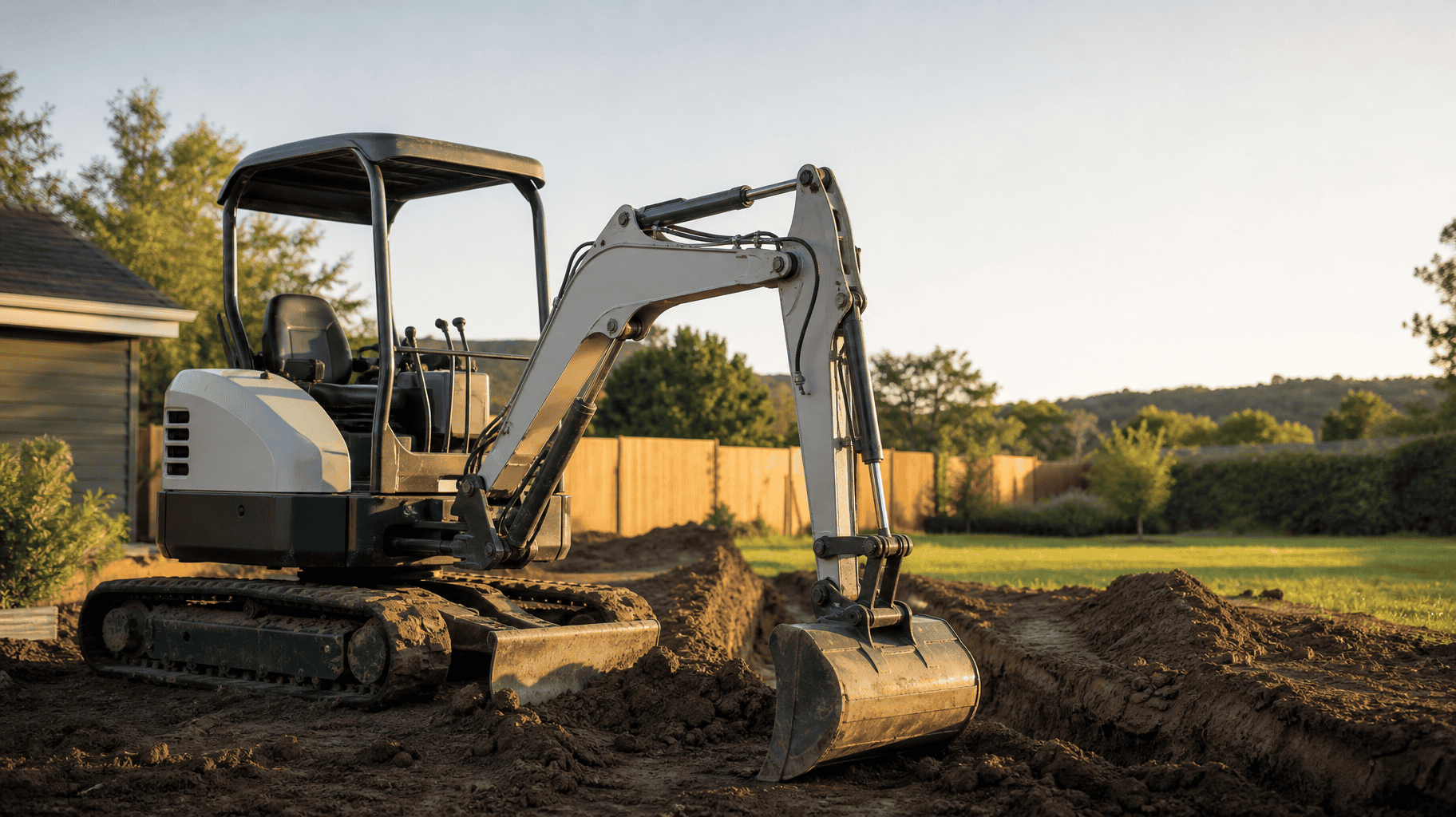
A mini excavator, also called a compact excavator, is a tracked digging machine typically weighing 1 to 10 metric tons. Small enough to squeeze through a backyard gate. Capable enough to dig trenches, foundations, and utility runs that would take days by hand. The machine swings 360 degrees on its tracks, runs hydraulic attachments, and the smaller classes ride on a standard equipment trailer behind a heavy-duty pickup.
It sits between handheld tools and full-size construction excavators. Mini excavators run on tracks, not wheels like a backhoe. They swing freely instead of pivoting from a fixed boom. And they’re built to dig, which sets them apart from a compact track loader or skid steer designed to lift. Picking the right size class is the biggest decision you’ll make. Cost scales hard with weight.
Mini Excavator Size Classes
The category breaks into six rough tiers. Sub-1-ton micro excavators handle landscaping and tight backyard work, starting around $20,000 to $30,000 new. The 1-to-2-ton class covers utility trenching and irrigation at $25,000 to $40,000. The 2-to-3-ton class is the workhorse of residential contractors, $30,000 to $50,000. Then comes the 3-to-5-ton class, the most popular segment by a wide margin, handling most small contractor jobs, including septic, foundation, and utility installation, $35,000 to $65,000 (well-equipped 3-to-4-ton machines mostly land in the $30,000 to $45,000 band). The 5-to-8-ton class steps into deeper digging at $50,000 to $80,000. The 8-to-10-ton class gets close to full-size capability while still being called compact, at $75,000 to $100,000 or more.
Every step up adds roughly $10,000 to $20,000. It also pushes up fuel use, transport requirements, and maintenance costs.
How Much Does a Mini Excavator Cost to Buy?
A new mini excavator costs between $20,000 for an entry-level 1-ton machine and over $100,000 for a fully-equipped 8-to-10-ton model from a premium brand. The most common segment, 3-to-4-ton machines from established manufacturers, typically runs $30,000 to $45,000 new. Used machines run 40% to 70% of new pricing depending on age, hours, and condition.
Brand Tier Pricing
Brand tier shifts pricing inside each class. Premium manufacturers like Caterpillar, Kubota, Kobelco mini excavators, Bobcat, John Deere, and Takeuchi charge 10% to 25% more than mid-tier or value brands for similar specs. What does that premium buy you? Deeper dealer support networks, longer parts availability, better resale value, and more refined hydraulics. For owners who can’t afford downtime, it’s worth it. For occasional users, less so. For a side-by-side look at leading mini excavator brands available in Australia, dealer inventory is the easiest place to compare specs.
Used Mini Excavator Prices and What to Look For
Used pricing usually lands at 40% to 70% of new. A 3-year-old machine with low hours from a reputable dealer might fetch 70% to 80% of the new price. A 7-year-old machine with 4,000 hours plus might be 30% to 50%. The hour meter matters more than calendar age. Machines under 2,000 hours give you the best value. Machines with over 5,000 hours are getting close to major service intervals where final drives, hydraulic pumps, and undercarriage components may need attention soon.
When you’re inspecting a used machine, three things matter most. First, the undercarriage condition. Sprocket teeth should be rounded, not pointed. Tracks should sit properly tensioned without sagging. Second, evidence of hydraulic leaks. Look for fresh oil under the machine and on the cylinder rods. Third, maintenance records. A documented service history is worth meaningfully more than the same machine without records, because you can verify that the 250-hour and 500-hour services were completed.
What Affects Mini Excavator Pricing
Beyond size and brand, a handful of things move the final price. Operating hours drive used valuations more than anything else, with prices dropping 5% to 10% per additional 1,000 hours. Attachments included in the sale add real value. A hydraulic thumb runs $2,000 to $4,000 retail. A quick coupler is $1,500 to $3,000. Speciality buckets are a few hundred each. A cab versus an open canopy adds $3,000 to $8,000. Tech features like telematics, GPS grading, and advanced hydraulic controls can pile on $5,000 to $30,000. Geographic market and local dealer inventory create regional swings of 10% or more on the same machine.
Operating Cost Per Hour: What You’ll Pay to Run It
The combined operating cost for a typical mini excavator runs $25 to $60 per hour when you account for fuel, allocated routine maintenance, insurance, and depreciation. Smaller 1- to 3-ton machines fall toward the low end. 5- to 8-ton machines fall toward the high end. This figure excludes operator labour, transport, and any major unplanned repairs.
Fuel Costs
A mini excavator in the 1-to-5-ton class burns 1 to 3 gallons per hour of diesel, depending on machine size, load, and operator habits. At a $4-per-gallon diesel benchmark, that translates to $4 to $12 per operating hour in fuel alone. Fuel is the largest single component of hourly operating cost for most owners.
A few conditions push fuel use higher. Hard digging in dense soil or rocky ground bumps consumption 20% to 30% over baseline. High-flow attachments like hydraulic breakers, mulchers, and augers work the engine harder than a standard bucket. Excessive idling is pure waste. Operator habits matter a lot, too. Aggressive throttle, sharp turns, and constant high-RPM operation push real-world consumption well above what the manufacturer advertises.
Hourly Cost Breakdown
Here’s a realistic hourly cost for a 3-ton machine working 500 hours a year. Fuel at $7 per hour. Allocated routine maintenance at $4 per hour ($2,000 annual maintenance divided by 500 hours). Allocated insurance at $1.50 per hour. Allocated depreciation at $4 to $8 per hour, depending on whether you bought new or used. That sums to roughly $16 to $20 per operating hour for moderate use, before any major repairs, transport, or labour.
Utilisation changes the math sharply. A few hours push per-hour costs up. Many hours pull them down. The full picture is in the Total Cost of Ownership section below.
Mini Excavator Maintenance Schedule: What and When
Mini excavator maintenance follows a four-tier schedule. A daily 5-minute walkaround. Weekly checks at roughly 50 hours of use. Hour-meter-based services at 250 hours, 500 hours, 1,000 hours, and 2,000 hours. And an annual professional inspection for machines in regular use. The schedule is designed so a disciplined owner can handle most routine maintenance themselves, while reserving hydraulic, final drive, and engine internal work for a qualified mechanic.
Daily Maintenance: The 5-Minute Pre-Operation Walkaround
The single most cost-effective maintenance habit is a quick visual check before you start the engine. Five minutes. That’s it. And it prevents an estimated 80% of major failures by catching small problems before they snowball. Check engine oil, hydraulic fluid, and coolant levels. Walk around the machine looking for fresh oil, fuel, or coolant under the chassis or on cylinders and hoses. Look at the rubber tracks for cuts, missing lugs, or exposed cords. Grease the bucket linkage and pivot points. Bucket pins need grease every operating day. Make sure attachments are secure and hydraulic couplings are clean.
Weekly / 50-Hour Maintenance
Every week, or every 50 operating hours, whichever hits first, the inspection gets deeper. Grease the slew bearing. This is the part that rotates the upper structure on the tracks, and it’s one of the most expensive components on the whole machine to replace if you let it run dry. Check track tension carefully. Wrong tension is the leading cause of premature undercarriage wear, and tracks that are too tight wear nearly as fast as tracks that are too loose. Clean accumulated debris from the undercarriage, especially if you’re working in clay or wet conditions. Inspect the air filter and replace it if it’s obviously dusty. Clean the radiator fins so cooling stays efficient.
Hour-Based Service Intervals
The major routine maintenance cycle runs on the hour meter, not the calendar.
At 250 hours. Replace engine oil and oil filter. Inspect the fuel filter. Inspect the hydraulic filter. Check all fluid levels and top off. Inspect drive belt tension. This is the workhorse interval. Most machines see a 250-hour service every 6 to 12 months in regular use.
At 500 hours. Replace the fuel filter and hydraulic return filter. Inspect coolant condition and top off or replace. Detailed undercarriage inspection, including roller and idler condition. Inspect all hydraulic hoses for chafing or weeping. Replace the cab air filters.
At 1,000 hours. Change the hydraulic fluid. The system holds the oil that does the actual work, and degraded hydraulic oil damages pumps, valves, and cylinders far more expensively than a fluid change costs. Flush coolant. Replace all engine and hydraulic filters. Thorough belt and hose inspection. Valve clearance check on most engines.
At 2,000 hours and beyond. Major service interval. Replace ageing hydraulic hoses. Service final drive oil. Full electrical system inspection. Complete hydraulic system service. Machines reaching 2,000 to 4,000 hours typically need their first significant component attention.
Owner-DIY Versus Dealer Service
Daily and weekly checks, plus oil-and-filter changes at 250-hour intervals, are well within the reach of an attentive owner with basic mechanical skills. The 500-hour and 1,000-hour services move into territory where many owners still handle them, especially with the service manual and decent tools. But hydraulic system internals, final drive service, engine internal repairs, and Tier 4 emissions diagnostics (modern emissions controls with sensor and electronic complexity) are a qualified mechanic’s job. Local mechanics without the right diagnostic tools can really struggle to balance them properly. That’s when professional machinery service from a dealer makes sense. NSW owners have options like STM Trucks & Machinery, with a workshop sized for B-Doubles and 24/7 emergency support for jobs that can’t sit idle.
Power Your Business with STM Trucks & Machinery
Whatever the size of your business, our experienced sales team will help you get the best from your budget.
Annual Maintenance Budget: What to Plan For
Annual routine maintenance for most 1-to-5-ton mini excavators runs $1,000 to $2,500 per year, covering fluids, filters, grease, minor wear items, and a basic seasonal service. Beyond routine costs, plan a 10% to 15% repair contingency on machine value once the equipment passes 3 years or 1,500 hours, when wear-item replacements and unplanned repairs become more frequent.
Routine maintenance components. The core $1,000 to $2,500 covers engine oil and filter every 250 hours, fuel and hydraulic filter replacements, hydraulic fluid every 1,000 hours, grease, coolant top-offs, cab air filters, and basic incidental supplies. Owners doing their own work fall toward the low end. Owners using dealer service tend toward the high end due to shop labour rates.
Wear items on cyclical schedules. A few items wear out on hour-based cycles instead of annually. Rubber tracks last roughly 1,500 to 3,000 hours and cost $1,000 to $3,000 per pair to replace. Bucket teeth and cutting edges wear every 1,000 to 2,000 hours and cost a few hundred dollars per set. Hydraulic hoses showing chafing or weeping should be replaced as you spot them. A $200 hose replacement is way cheaper than the cleanup and downtime from a hose blowing on a job site. For most wear items, genuine and aftermarket spare parts are available through dealer parts networks.
Repair contingency. First-time buyers usually budget the routine number and stop there. That’s exactly where total cost of ownership surprises happen. Set aside 10% to 15% of the machine value annually after year three. On a $40,000 machine, that’s $4,000 to $6,000 a year as a planning figure. Not all of which gets spent every year. But the years when something major goes wrong, the reserve absorbs the hit.
Major Repair Costs: The Big-Ticket Items
Three categories drive most of the large unplanned repair bills on mini excavators. Hydraulic system failures (consistently cited as one of the leading sources of major breakdowns). Undercarriage wear (which represents up to 50% of lifetime maintenance costs). And engine or final drive issues (rarer but the most expensive when they occur). Catching small problems early through daily inspection is dramatically cheaper than addressing component failures after they cascade.
Hydraulic System Repairs
The hydraulic system powers everything that moves on a mini excavator. It’s also where most breakdowns start. Repair costs span a wide range. A blown hydraulic hose costs $200 to $400 to replace, including labour. Cheap if you caught it at a fitting weep. It would be expensive if it failed at full pressure and contaminated the system. A cylinder reseal (fixing seals that leak past the rod) runs $500 to $1,200. A failed hydraulic pump replacement, including labour, lands between $2,000 to $3,500 for most mini excavators. That’s the value end. Some premium-brand pumps push higher.
The pattern is consistent. Catch leaks at the first sign of weeping fluid, and you’re looking at a $300 fix. Let a leak progress until pressure drops or contamination spreads, and you’re looking at a $3,000 repair. The daily walkaround pays for itself many times over in hydraulic costs alone.
Undercarriage Wear and Replacement
The undercarriage (tracks, sprockets, rollers, and idlers) eats up to half of total lifetime maintenance costs on a tracked machine. That sounds like a lot, but it makes sense once you see how the components interact. When one wears past spec, it accelerates wear on the others. Loose tracks scallop the sprocket teeth. Pointed sprocket teeth then chew the tracks faster. Worn rollers throw alignment off and stress the whole system.
Individual component costs are manageable in isolation. Rubber tracks run $1,000 to $3,000 per pair. Sprockets, rollers, and idlers run a few hundred dollars each. A full undercarriage rebuild on a 3-to-5-ton machine, where you replace all the major components together, typically runs $5,000 to $15,000, depending on size and brand. The way to keep this category manageable is exactly what the maintenance schedule prescribes. Clean the undercarriage after dirty work. Keep track of tension correct. Limit aggressive moves like high-speed reverse travel and sharp pivot turns.
Engine and Final Drive Repairs
Engine repairs are less frequent than hydraulic or undercarriage work. But more expensive when they hit. Minor engine work, like sensor replacement, fuel injector service, and turbocharger components, runs $1,000 to $3,000. A full engine rebuild or replacement starts at $6,000 and climbs higher on premium machines or those with Tier 4 emissions complications. Modern emissions systems add diagnostic complexity that often forces you to visit a dealer service.
Final drive motors transfer power from the hydraulic system to the tracks. They also multiply torque for digging and travel. A failed final drive on a mini excavator runs $5,000 or more per side to replace, including labour. Symptoms include grinding noises during travel, reduced power, oil leaks from the drive housing, and resistance during turns. Same story as hydraulic components. Address symptoms early, usually a seal replacement or oil change, and you sidestep the much bigger bill that comes from running it to failure.
Insurance and Registration
Most owners carry contractors’ equipment or inland marine insurance (coverage for equipment in transit and on site) to cover mini excavators. Annual premiums typically run 1% to 3% of machine value. So a $40,000 machine costs you roughly $500 to $1,200 a year, depending on coverage scope, deductible, geographic risk, and how often the machine moves between job sites. Coverage usually includes theft, on-site damage, transit between locations, and equipment breakdown endorsements.
Two coverage gaps catch new owners off guard. Standard homeowners’ insurance generally does not cover business equipment, even on residential property. And many policies exclude damage during transit or operation by unlisted operators. Worth reading the policy carefully if you’ll loan or rent the machine. Registration requirements vary by state. Most mini excavators stay on trailers between job sites and don’t require registration, but check your local rules. Insurance terms and registration rules change regularly. Verify current requirements with your state regulator and your insurer before relying on any figure here.
Depreciation and Resale Value
Most mini excavators lose a significant portion of their value in the first 5 years of ownership, often in the 30% to 50% range, depending on hours, brand, and condition. The steepest drop hits in years 1 and 2. The category retains value better than full-size excavators because of broader resale demand from both contractors and homeowner-buyers. Hours of use, brand reputation, and maintenance records typically influence resale price more than calendar age alone.
The depreciation curve isn’t linear. A new machine drops 10% to 20% the moment it leaves the dealer’s lot. Then 8% to 12% per year through years 2 and 3. Then it flattens to a slower decline as the machine settles into used-market value. Premium brands hold value better through the curve. A 5-year-old Kubota or Caterpillar usually fetches 5% to 10% more than a 5-year-old equivalent from a value brand. But the absolute dollar gap narrows over time. At 8 to 10 years, the gap often disappears.
What separates strong resale from weak resale within the same brand and age? Maintenance documentation. A 5-year-old machine with 2,500 hours, complete service records, and clean cosmetic condition will sell within a few weeks at the upper end of its value range. The same machine, with no service records and visible neglect (leaks, a scarred undercarriage, mismatched tracks), sits on the market longer and sells at the bottom. The 5-minute daily walkaround and the basic service log that takes another two minutes a week are, in pure dollar terms, two of the most cost-effective habits an owner can build. Records also protect warranty claims if anything goes wrong during the coverage period.
Total Cost of Ownership: Putting It All Together
Across a 5-year ownership period, a typical 3-ton mini excavator purchased new for $40,000 and run 500 hours per year will cost roughly $54,000 to $57,000 net of resale value, about $21 to $23 per operating hour all-in. The math shifts substantially with utilisation. A homeowner running 100 hours per year sees per-hour costs near $50. A heavy-use small contractor running 1,000 hours per year drops to roughly $14 to $16 per hour.
Working through a sample makes it concrete. Take a $40,000 machine, 500 hours per year, 5 years (2,500 total hours, well within typical service life). Fuel ($17,500), routine maintenance ($10,000), major repairs and wear-item replacements ($5,000 to $8,000), and insurance ($4,000) total roughly $36,500 to $39,500. Subtract a year-5 resale value of about $22,000 for a well-maintained machine, and the net cost lands at $54,000 to $57,000.
The same $40,000 machine in a homeowner’s hands at 100 hours per year over 5 years (500 total hours) sees lower fuel and maintenance costs, but the same insurance, depreciation, and storage burden. Per-hour figure pushes toward $50. A small contractor at 1,000 hours per year sees more wear and higher fuel, but spreads fixed costs across far more hours and lands at $14 to $16. Ownership math is mostly a function of hours used. If you can’t reliably hit 400 hours a year, the per-hour cost climbs sharply and renting starts to look better.
Should You Buy or Rent?
The breakeven between buy vs rent comes down to usage hours per year. Renting consistently wins for occasional use. Below 25 days per year (roughly 200 operating hours), the rental math beats ownership cleanly. Owning consistently wins for heavy use. Above 50 days per year (roughly 400 operating hours), the per-hour math, attachment availability, and zero-lead-time access all favour ownership. The middle band, between 25 and 50 days, is where you need a real spreadsheet comparing your local rental rates against the ownership math from the prior section.
Local rental pricing usually runs $200 to $575 per day, $700 to $1,550 per week, and $1,800 to $4,000 per month for mini excavators in the popular size classes. These figures are typical industry ranges. Get current quotes from local rental yards before committing, since rates vary widely by season, location, and machine spec. Weekly rates almost always beat daily rates by a wide margin. A 4-day project usually costs less rented weekly than rented daily. For owners somewhere in the middle band, lease-to-own and long-term rental arrangements can bridge the gap. They let you test ownership economics without committing to the full purchase price. Once the math points to ownership, browsing new and used mini excavators at an established dealer is the fastest way to compare current pricing and availability.
Reducing Costs Over the Long Run
Most ownership-cost variance comes down to operator habits, not the machine itself. Operator behaviour drives an estimated 20% to 30% of total wear and fuel cost. Smooth controls, gradual movements, wide turns instead of sharp pivots, and limiting high-speed reverse travel all add up over thousands of hours. Two other low-effort wins matter too. Run quality hydraulic fluid and genuine or quality aftermarket filters on the spec’d intervals. Bargain-bin alternatives are the most common cause of premature pump and valve wear. And clean the undercarriage after dirty work, especially in clay or wet conditions, where packed mud holds moisture against metal and grinds rollers and tracks together.
Mini Excavator Cost & Maintenance FAQ
How much does it cost to maintain a mini excavator per year?
Routine maintenance on a 1-to-5-ton mini excavator runs $1,000 to $2,500 per year, covering fluids, filters, grease, and minor wear items. Add a 10% to 15% repair contingency on machine value once the equipment passes 3 years or 1,500 hours, since wear items and unplanned repairs become more frequent as the machine ages.
How long does a mini excavator last?
With proper maintenance, mini excavators reach 8,000 to 12,000 hours of service life. That translates to roughly 10 to 15 years for light or homeowner use at 100 to 300 hours per year, and 5 to 7 years for heavy commercial use at 1,500 to 2,000 hours per year. Disciplined daily and hour-based maintenance is the largest single factor in reaching the upper end of that range.
How much fuel does a mini excavator use per hour?
A mini excavator in the 1-to-5-ton class burns 1 to 3 gallons per hour of diesel under normal operating conditions. At a $4-per-gallon diesel benchmark, that works out to roughly $4 to $12 per operating hour in fuel. Larger machines, harder digging conditions, and high-flow attachments push consumption toward the upper end.
Is it cheaper to rent or buy a mini excavator?
Renting is almost always cheaper for below 25 days of annual use (roughly 200 operating hours). Owning is almost always cheaper above 50 days per year (roughly 400 operating hours). Between those thresholds, the right answer depends on local rental rates, transport costs, and how often a machine being unavailable would force you to turn down work or delay projects.
The Bottom Line on Mini Excavator Cost and Maintenance
Predictable costs are manageable. Fuel, routine maintenance, insurance, and gradual depreciation all fit into a budget if you know the numbers going in. It’s the unpredictable costs that break first-time owners. The hydraulic failure in year 4. The undercarriage needed rebuilding sooner than expected because track tension drifted. The missed daily check that turned a $300 fix into a $3,000 repair. Disciplined maintenance is the single biggest variable an owner controls.
The next step before buying is straightforward. Estimate your realistic annual usage hours. Build a one-page total cost of ownership sheet using the figures from this article. Compare against current local rental rates for the size class you’re considering. For NSW buyers, STM Trucks & Machinery operates a full-service workshop that handles machinery service and truck servicing under one roof.
One last note. Individual results vary significantly. The figures, ranges, and timelines in this guide are typical industry numbers, not guarantees. Machine condition, usage patterns, regional pricing, and current market conditions all shift outcomes in either direction. Treat the article as a starting point, not the last word, and verify current numbers with local dealers before committing to a purchase.