Your excavator bucket determines how much material you move per hour. Clay needs heavy-duty designs with thick cutting edges. Sand eats through standard steel – you need hardened wear protection. Rock breaks teeth and cracks buckets without extreme-duty construction.
Get it wrong and productivity drops 40%. Standard buckets in rock? Teeth fail every 100 hours instead of 300-400. Using 0.7m³ capacity when you could run 1.0m³? You’re adding extra cycles and wasting time.
The right bucket pays for itself within weeks through higher output and lower maintenance.
Power Your Business with STM Trucks & Machinery
Whatever the size of your business, our experienced sales team will help you get the best from your budget.
Quick Bucket Selection Guide
| Soil Type | Bucket Type | Key Feature | Service Life | Cost Range |
| Clay | Heavy-duty | 20-25mm cutting edges | 800-1,200 hours | £3,500-5,000 |
| Sand | Wear-protected | AR400 steel plate | 1,000-1,500 hours | £2,800-4,200 |
| Rock | Extreme-duty | Reinforced carbide teeth | 800-1,500 hours | £4,000-6,500 |
| Loose materials | Skeleton bucket | 50-150mm bar spacing | 2,000-3,000 hours | £2,200-3,800 |
| Silt/finishing | Tilt bucket | 45° hydraulic angle | 1,500-2,500 hours | £4,500-7,000 |
| Swamp/wet | Flotation bucket | 50-100% oversized | 1,200-2,000 hours | £3,200-4,800 |
How Soil Properties Affect Bucket Performance
Soil characteristics determine which bucket design works. Dense clay needs a penetration force. Loose sand needs wear protection. Rock needs impact resistance.
Key soil factors:
Density and compaction – Dense clay requires 18-25 tonnes of breakout force on a 20-tonne excavator. Loose sand needs 20-30% larger capacity to prevent overloading.
Abrasiveness – Sand particles remove 2-5mm of steel thickness per 500-1,000 hours. Rock creates impact damage that cracks standard buckets within days.
Particle size – Fine particles infiltrate hydraulic seals. Reduces cylinder seal life from 5,000-8,000 hours to 2,000-4,000 hours. Large rocks jam between teeth spaced too close together.
Moisture content – Wet clay sticks to bucket interiors. Doubles cycle times. Saturated soil in swamps creates flotation problems.
Match your bucket to these characteristics, and you’ll move more material with less wear.
Heavy-Duty Buckets for Clay Soil
Clay creates unique problems. High cohesion when dry. Sticky and heavy when wet. Standard buckets lack the strength to penetrate compacted clay. They can’t handle the adhesion that slows cycle times by 20-35%.
Selecting appropriate excavator attachments beyond buckets—including hammers, grapples, and rippers-expands operational capabilities for diverse soil conditions. Multi-tool versatility reduces equipment investment while improving project flexibility.
Why Standard Buckets Fail
Standard buckets use 12-16mm thick steel. Not enough for compacted clay that needs 2-3 times the normal breakout force. Tooth spacing of 200-250mm with 45-60° angles only achieves 60-75% of the required penetration. Smooth internal surfaces let clay stick and build up. You’re cleaning the bucket manually every 15-20 cycles.
Heavy-Duty Specifications
Cutting edges: 20-25mm thick vs 12-16mm standard. Made from AR400 or AR500 steel with 400-500 Brinell hardness. These edges concentrate 20-30% more force per unit area.
Sidewall construction: 10-16mm thick vs 8-12mm standard. Gussets every 200-300mm instead of 400-600mm. Prevents structural failure under 25-30 tonne breakout forces.
Tooth systems: Sharper 30-40° tip angles vs standard 45-60°. Penetration length of 150-200mm. Spacing of 180-220mm enables maximum soil engagement without jamming.
Internal design: Smooth surfaces with better release angles. Material slides out instead of sticking. Cuts cycle times by 15-25%.
Knowing when to swap between bucket types as soil conditions change maximises productivity throughout multi-phase excavation projects. Quick-hitch systems enable 30-90 second changeovers versus 15-30 minute manual pin installations.
A contractor excavating a retail site near Birmingham used standard buckets in heavy clay. Went through six sets of teeth in three weeks at £400 per change. Switched to heavy-duty buckets. Still running the first set after two months.
Heavy-duty buckets cost £3,500-5,000 for 1.0m³ capacity. Standard buckets run £2,500-3,500. That £1,000-1,500 premium pays back through teeth lasting 300-400 hours instead of 100 hours and moving 90-120m³/hour instead of 60-80m³/hour.
Wear-Protected Buckets for Sandy Soil
Sand excavates easily but destroys buckets fast. Quartz particles grind away steel like sandpaper. Inadequate buckets wear out within hundreds of hours instead of thousands.
Challenges in Sandy Conditions
Rapid wear – Abrasive particles remove 2-5mm of steel per 500-1,000 hours. Standard cutting edges wear out in 300-500 hours. Premium edges last 1,000-1,500 hours.
Overloading risk – Loose sand enables overfilling by 20-30% beyond rated capacity. Hydraulic systems strain. Fuel consumption increases.
Seal contamination – Particles under 0.1mm infiltrate hydraulic seals. Seal life drops from 5,000-8,000 hours to 2,000-4,000 hours.
Wear Protection Systems
Hardened overlays: AR400 or AR500 plate with 400-500 Brinell hardness. Applied in 6-12mm thickness to bucket floors and sidewalls. Extends life 3-5 times.
Reinforced edges: Premium alloy with chromium carbide overlays. Through-hardened steel at 450-550 Brinell hardness. Service life extends from 300-500 hours to 1,000-1,500 hours.
Strategic liners: Wear plates protect critical areas without adding unnecessary weight. Focus on the bucket floor, lower sidewalls, and radius areas.
Enhanced filtration: Upgraded hydraulic filters catch fine particles before they damage seals. Adds £200-400 initially. Saves £2,000-4,000 in cylinder repairs over 2-3 years.
Wear-protected buckets cost £2,800-4,200 for 1.0m³ capacity. Standard buckets run £2,000-3,000. A quarry operator near Leeds switched from standard to wear-protected buckets. Cutting-edge replacement dropped from every 350 hours to every 1,200 hours. Saved £4,800 annually per machine.
Extreme-Duty Buckets for Rock Excavation
Rock excavation demands the strongest construction available. Standard buckets fail within days. Extreme-duty designs handle continuous impact and abrasive wear.
Structural Requirements
Thicker walls: 12-18mm sidewalls vs 8-12mm standard. Rock buckets weigh 950-1,200kg vs 650-800kg for 1.0m³ capacity. High-strength steel with 350-450 MPa yield strength prevents structural failure from 15-25 tonne impacts.
Intensive gusseting: Gusset plates every 150-200mm vs 300-400mm standard. Reinforced pin bosses with 40-50mm wall thickness distribute impact forces throughout the bucket.
Enhanced base: 16-20mm floor plate vs 10-14mm standard. Prevents puncture from sharp rock edges.
Specialised Tooth Systems
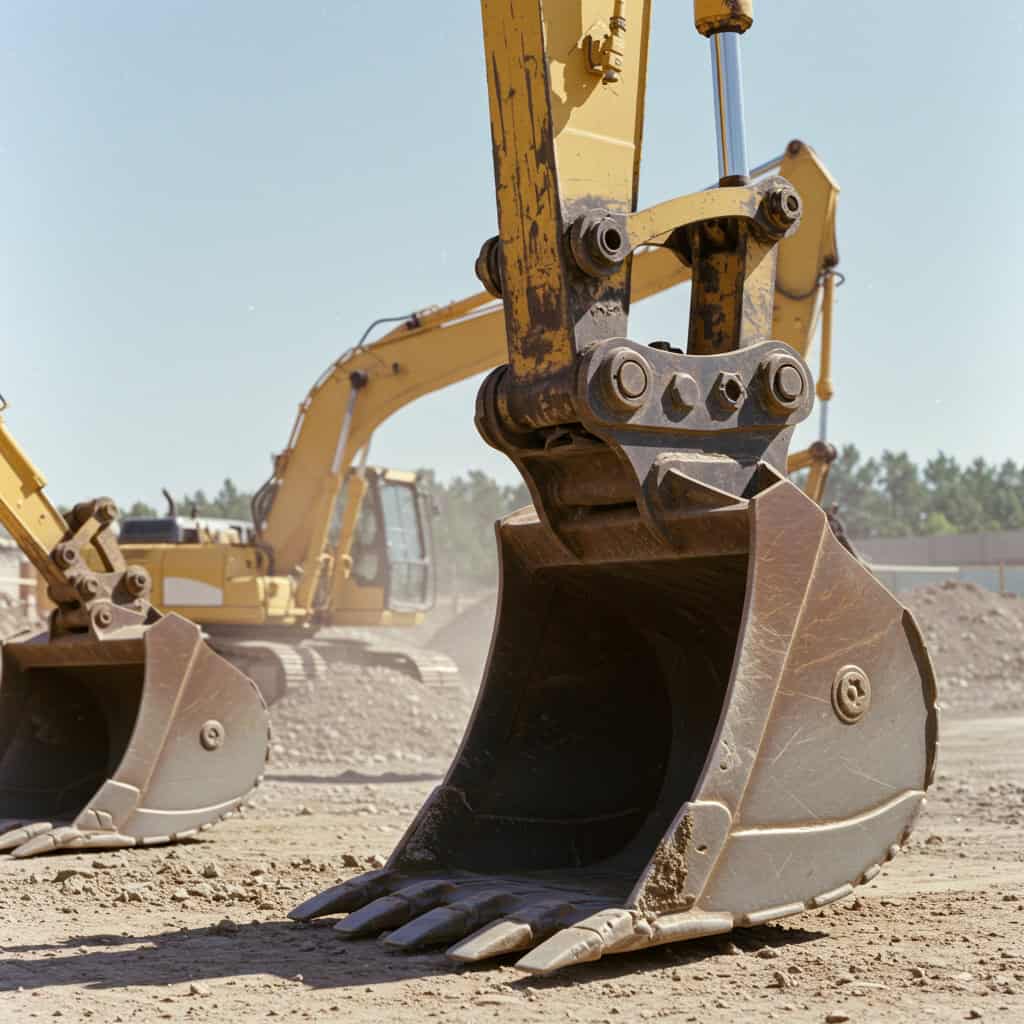
Shorter, stronger profiles: 80-120mm exposed length vs 150-200mm standard. Thicker 60-80mm shanks. Blunter 60-80° tip angles resist breakage under 10-15 tonne impacts per tooth.
Wider spacing: 250-350mm centres vs 180-250mm for clay buckets. Prevents rocks from jamming between teeth.
Premium materials: Tungsten carbide inserts with compressive strength exceeding 5,000 MPa. Service life extends from 200-400 hours with standard teeth to 800-1,500 hours with premium rock teeth.
Performance Economics
| Bucket Type | Cutting Edge | Service Life in Rock | Cost per 1,000 Hours |
| Standard | 16mm | 50-100 hours | £3,000-6,000 |
| Heavy-Duty | 20-25mm | 200-400 hours | £1,250-2,500 |
| Rock Bucket | 25-30mm | 800-1,200 hours | £420-1,000 |
Rock buckets cost £4,000-6,500 vs £2,500-3,500 for standard designs. That premium delivers 10-15 times longer service life in rocky conditions.
A demolition contractor in Manchester excavated foundations through bedrock. Started with heavy-duty buckets. Replaced cutting edges every 180 hours at £450 each. Switched to rock buckets. Running 900 hours on original edges. Saved £1,800 in six months per excavator.
Skeleton Buckets for Loose Materials
Skeleton buckets excel at sorting loose materials. Feature parallel bars with 50-150mm spacing. Fine material falls through during digging. Larger particles stay in the bucket. You excavate and sort in one operation.
Key Advantages
Eliminates separate screening: Saves £200-400 daily equipment rental. Eliminates screening operator wages of £150-250 per day. Productivity improves 15-25% through single-pass operations.
Reduced weight: Load weights drop 20-40% as fines fall through. You’re moving 0.8-1.0 tonnes vs 1.2-1.5 tonnes. Cycle times decrease from 25-30 seconds to 18-22 seconds. Fuel consumption drops 8-15%.
Self-draining: Water and mud drain automatically. Stays light in wet conditions.
Application Guidelines
Fine retention (50-75mm spacing): Topsoil screening, crushed aggregate separation, landscaping where material recovery exceeds 90%.
Coarse throughput (100-150mm spacing): Demolition debris sorting, large aggregate screening, land clearing, separating logs from soil.
A landscaping company in Bristol screens topsoil for residential projects. Previously rented a screening plant at £280 per day. Bought a skeleton bucket for £2,800. Paid for itself in 10 days. Now screens on-site while loading trucks. Saves 2-3 hours per job.
Skeleton buckets cost £2,200-3,800 for 1.0m³ capacity. Last 2,000-3,000 hours because material weight and impact forces stay low.
Tilt Buckets for Finishing Work
Silt and fine soils need precision handling. Finishing work demands grade tolerances within ±25mm. Standard fixed buckets achieve ±50-75mm at best.
Why Standard Buckets Struggle
Fixed buckets can’t achieve precise grades without constant repositioning. Each reposition takes 5-15 minutes. Creates surface irregularities needing manual rework.
Tilt Bucket Technology
Tilt buckets add hydraulic tilting mechanisms. Provide 45° angling in either direction – total 90° working range.
Precision capabilities:
- Grade tolerance within ±25mm vs ±50-75mm with fixed buckets
- Slope angles maintained within ±2°
- Finish grading without excavator repositioning
Productivity improvements:
- Complete slope work in 2-3 hours vs 4-6 hours
- Productivity improves 30-50% in finishing operations
- Fuel consumption reduces by 20-30%
A civil contractor in Leeds does final grading for commercial sites. Bought tilt buckets for two excavators at £5,200 each. Finishing time dropped from 8 hours to 4 hours per project. The equipment paid for itself within 12 projects.
Tilt buckets cost £4,500-7,000 for 0.8-1.2m³ capacity.
Flotation Buckets for Swamp Conditions
Swamp conditions feature saturated soils with minimal bearing capacity. Standard buckets sink 300-600mm into soft substrates. Recovery takes 1-3 hours and costs £500-1,500 per incident.
Flotation Design
Enlarged capacity: 50-100% larger than standard. 1.5-1.8m³ vs 1.0m³ on 20-tonne excavators. An extended base width, 30-50% wider, distributes weight over larger surface areas.
Lightweight construction: High-strength steel in reduced thicknesses of 8-12mm vs 10-16mm standard. Reduces overall weight by 15-25%. Buckets weigh 750-900kg vs 1,000-1,200kg for comparable capacity.
Sealed systems: Sealed bearings resist contamination from organic debris and water. Drainage provisions prevent material retention.
Flotation buckets cost £3,200-4,800 for 1.5-1.8m³ capacity. A premium of £400-800 eliminates bogging incidents and enables work in restricted access areas.
A drainage contractor in the Lake District lost two days extracting a bogged excavator. Cost £2,400 in crane rental and labour. Bought flotation buckets for £3,600. Hasn’t had a bogging incident in 18 months.
How to Select the Right Bucket
Soil Assessment
Check density and compaction: High-density clay needs heavy-duty penetration. Low-density sand needs capacity management.
Evaluate abrasiveness: Sand and decomposed granite create extreme wear. Rock creates impact damage.
Measure particle size: Fine particles cause seal contamination. Large rocks need wide tooth spacing.
Consider moisture: Wet conditions affect handling and flotation. Dry conditions increase abrasiveness.
Project Requirements
Productivity targets: Calculate required material movement. Match bucket capacity to excavator size and target output.
Timeline constraints: Tight schedules justify premium buckets for faster cycles.
Quality standards: Finishing work needs tilt buckets. Rough excavation accepts standard designs. Sorted materials need skeleton buckets.
Budget considerations: Evaluate lifecycle costs, not just purchase price.
Lifecycle Cost Analysis
Total cost over 3,000-5,000 hours reveals real economics.
Example calculation:
A contractor runs a 20-tonne excavator 1,500 hours annually in mixed clay and rock.
Standard bucket:
- Initial cost: £2,800
- Tooth replacement (every 150 hours): £4,000/year
- Cutting edge (every 400 hours): £600/year
- Productivity: 70m³/hour
- Total annual cost: £5,400
Premium rock bucket:
- Initial cost: £4,500
- Tooth replacement (every 500 hours): £1,200/year
- Cutting edge (every 900 hours): £250/year
- Productivity: 95m³/hour
- Total annual cost: £1,450
- Plus 25m³/hour × 1,500 hours × £10/m³ = £375,000 additional revenue
The premium bucket pays for itself within the first month through reduced maintenance. Productivity gains add substantial revenue.
Maintenance Best Practices
Heavy-Duty and Rock Buckets
Daily inspections (5-10 minutes):
- Check for cracks in welds
- Verify teeth are tight
- Inspect cutting-edge condition
Systematic procedures for inspecting excavator attachments catch wear patterns, structural cracks, and loose components before they cause costly failures or safety incidents. Document findings to track replacement intervals and predict maintenance needs.
Component replacement timing:
Cutting edges: Replace at 50-70% wear. The original 25-30mm thickness should be replaced with 8-15mm remaining.
Replacement frequency:
- Rock excavation: every 200-300 hours
- Heavy clay: every 350-450 hours
- Abrasive sand: every 250-400 hours
- Cost: £300-600 including labour
Teeth: Replace when the length reduces by 40-60%. Original 150-200mm should be replaced with 60-100mm remaining.
Replacement frequency:
- Rock with standard teeth: every 150-250 hours
- Rock with premium teeth: every 800-1,500 hours
- Cost: £25-80 per tooth, £200-800 per full set
Replace individual teeth as they wear. Prevents adapter damage costing £80-200 each vs £25-80 for teeth.
General Purpose Buckets
Daily checks: Visual inspection for damage, loose components, and operational irregularities.
Scheduled services: Lubricate pivot points every 50 hours. Assess wear components every 200 hours.
Between-project storage: Clean thoroughly. Lubricate all pivot points. Store under cover. These practices extend component life 20-30%.
Common Bucket Selection Mistakes
Using general-purpose buckets in rock – Teeth wear out every 100 hours instead of 800-1,500 hours. Costs £400-800 per tooth and needs to be changed every few weeks instead of every year.
Undersizing capacity – Using 0.7m³ when you could run 1.0m³ adds 30% more cycles. Wastes 30 hours on a 1,000-cycle project. At £80/hour operating cost, that’s £2,400 wasted.
Oversizing capacity – Overfilling loose materials by 20-30% overloads the excavator. Component wear accelerates. Tip-over risk increases.
Ignoring wear protection – Standard steel in sand wears 3-5 times faster. Bucket replacement occurs at 1,000-1,500 hours instead of 3,000-4,000 hours.
Buying on initial price alone – A £2,500 standard bucket lasting 1,000 hours costs more than a £4,000 premium bucket lasting 3,500 hours when you factor in replacement costs and lost productivity.
Final Recommendations
Match your bucket to your soil. Clay needs heavy-duty penetration. Sand needs wear protection. Rock needs impact resistance. Calculate lifecycle costs, not just purchase price.
A £4,000 rock bucket lasting 3,500 hours costs less per hour than a £2,500 standard bucket lasting 1,000 hours. Factor in productivity gains of 20-40% and maintenance savings of £2,000-5,000 annually. Premium buckets pay for themselves within weeks.
Maintain your equipment properly. Daily inspections catch problems early. Scheduled component replacement prevents expensive failures. Proper storage extends service life 30-50%.
Important: Performance figures and costs represent general industry ranges. Results vary by soil type, equipment, operator skill, and conditions. Calculate returns based on your actual operations. Consult equipment manufacturers for advice specific to your needs.