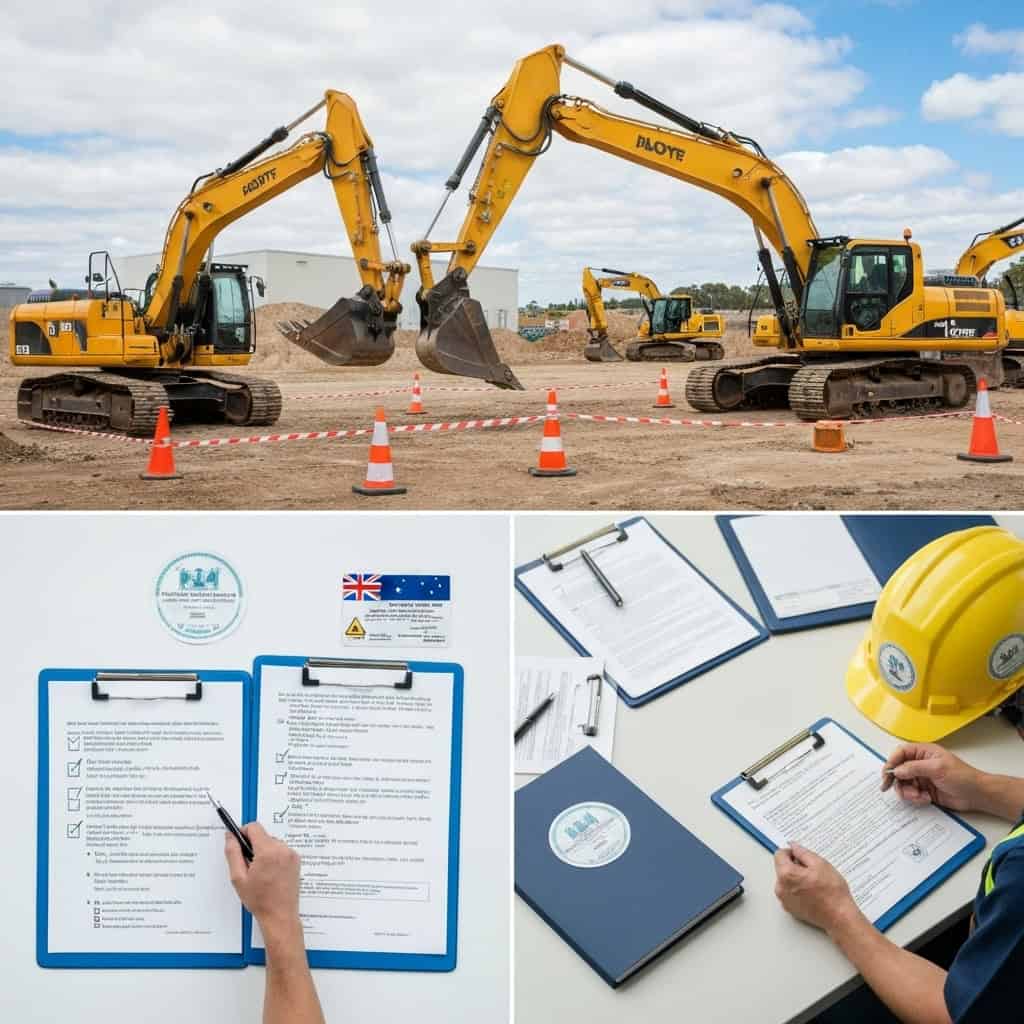
Australian excavator regulations changed in 2011 when the Work Health and Safety Act introduced a competency-based system. The new law removed specific excavator permits. It placed legal responsibility on businesses to verify the competency of their operators.
You must now prove your operators can handle excavators safely. The government no longer issues permits for excavator operation. Your business carries the legal responsibility for ensuring operators understand excavator fundamentals and safe operating practices.
Understanding current regulatory requirements remains crucial for operators and employers to maintain compliance and avoid substantial penalties.
The competency-based framework requires Persons Conducting a Business or Undertaking (PCBUs) to assess and verify operator capabilities rather than relying on government-issued licences. This system focuses on practical skills, safety knowledge, and ongoing competency maintenance. It keeps safety standards high across Australian construction sites.
You must demonstrate practical skills. You need current safety knowledge. You must maintain your competency over time. Safety standards remain high.
Power Your Business with STM Trucks & Machinery
Whatever the size of your business, our experienced sales team will help you get the best from your budget.
Australian Regulatory Framework for Excavator Operations
Work Health and Safety Act Overview and PCBU Responsibilities
The Work Health and Safety Act 2011 changed excavator operation requirements. It removed specific machinery licenses for most earthmoving equipment. The law introduced the PCBU concept. This makes business owners and managers legally responsible for worker competency and workplace safety.
You must assess operator competency through systematic evaluation. Cover technical skills, safety knowledge, and practical application. You cannot delegate this assessment responsibility. You may engage qualified assessors, but legal responsibility stays with your business. You need documentation, including competency assessments, training records, and supervision arrangements.
You must provide training, supervision, and resources for safe excavator operation. Make sure operators understand site hazards, equipment limitations, and emergency procedures. Regular competency reviews maintain continued capability and compliance with safety requirements.
Fail to meet PCBU obligations and you face substantial penalties. Fines reach $300,000 for individuals and $1.5 million for corporations. Poor competency assessment and safety management carry serious legal consequences.
Competency-Based System vs Traditional Licensing
The competency-based system focuses on practical capability over paperwork. You must keep demonstrating skills. You cannot rely on a one-time license. This approach allows flexible assessment methods. You can use formal training, competency verification, or workplace evaluation.
Traditional licensing provided standard qualifications. It often missed specific workplace requirements or equipment variations. The competency system allows tailored assessment. It reflects your actual job requirements, equipment types, and site hazards.
Competency assessment must cover machine operation, safety procedures, hazard recognition, and emergency response. Assessors watch your practical skills through observed performance. They test theoretical knowledge through written or verbal examination. This approach verifies you have both technical capability and safety awareness.
The system recognises prior learning through verification of competency processes. Experienced operators can demonstrate existing skills without completing full training courses. This flexibility cuts training costs while maintaining safety standards.
State and Territory Variations in Excavator Regulations
NSW, QLD, and VIC Specific Requirements
New South Wales handles excavator rules through SafeWork NSW. They give you guidance on competency assessment and workplace safety. Follow their rules.
NSW requires documented competency assessment for all earthmoving equipment operators, with particular emphasis on risk assessment and hazard management.
Queensland’s Workplace Health and Safety Queensland provides detailed guidance on excavator operation with specific requirements for high-risk construction work. Queensland emphasises Safe Work Method Statements for excavation activities and maintains strict documentation requirements for competency assessment.
Victoria, through WorkSafe Victoria, implements comprehensive excavator safety requirements with specific guidance on plant safety and operator competency. Victorian regulations emphasise consultation requirements and mandate specific training for high-risk activities, including trenching and demolition work.
All three states maintain similar core requirements but differ in documentation specifics, assessment procedures, and enforcement priorities. You work across multiple states? You must follow the strictest rules that apply to you.
WA, SA, TAS, NT, and ACT Regulatory Differences
Western Australia runs excavator rules through WorkSafe WA. They focus hard on mining and resource operations. You must meet specific competency requirements in high-risk environments. You need ongoing supervision.
South Australia’s SafeWork SA provides guidance on excavator operation with specific requirements for construction and infrastructure projects. SA emphasises risk management planning and requires documented competency assessment for all operators.
Tasmania implements regulations through WorkSafe Tasmania with a focus on forestry and agricultural applications common in the state. Tasmanian requirements emphasise environmental considerations and specific training for challenging terrain operations.
Northern Territory and Australian Capital Territory maintain similar requirements to larger states, but with modified enforcement approaches reflecting smaller jurisdictions and specific industry needs.
Excavator Competency Requirements and Assessment
Defining Operator Competency Standards
Excavator operator competency covers technical skills, safety knowledge, and practical application. You need these skills in different operating conditions. You must control machines well, recognise hazards, and respond to emergencies properly.
For technical competency, you need to understand hydraulic systems, controls, stability, and attachments. Show smooth machine control and proper work techniques. Handle maintenance procedures correctly. For load handling, you must know capacity limits, lifting procedures, and material handling safety.
Safety competency covers hazard identification, risk assessment, personal protective equipment usage, and emergency response procedures. You must understand site hazards. These include overhead power lines, underground utilities, unstable ground, and proximity to other workers or equipment.
Practical application requires you to show competency under actual working conditions. This includes various soil types, weather conditions, and operational scenarios. Assessment must cover routine operations and emergency response. This shows your complete capability.
Training Pathways and Registered Training Organisations
Formal training pathways include nationally recognised courses such as RIIMPO320F (Conduct civil construction excavator operations) and RIIMPO301E (Conduct hydraulic excavator operations). These courses typically require 2-5 days for completion, depending on the course scope and operator experience.
Training covers machine familiarisation, excavator safety procedures, operating techniques, maintenance requirements, and regulatory compliance. You get supervised machine operation, skills demonstration, and competency assessment under different conditions.
Registered Training Organisations must maintain national recognition and hold proper qualifications for excavator training. RTOs provide structured learning, assessment against national standards, and competency documentation. This documentation works across Australian jurisdictions.
Choose courses based on your specific equipment types, operating environments, and intended applications. Specialised courses cover unique requirements like long-reach excavators, demolition work, or precision digging techniques.
Verification of Competency (VOC) Process
Verification of Competency gives experienced operators an alternative assessment without formal qualifications. VOC assessment happens on-site using your actual equipment and working conditions. This evaluates your practical competency and safety knowledge.
VOC assessors must hold appropriate qualifications and experience in excavator operation and safety assessment. Assessment covers all competency elements, including technical skills, safety procedures, and regulatory compliance understanding.
VOC documentation includes competency mapping, practical assessment, and theoretical evaluation results. This documentation provides equivalent recognition to formal training qualifications whilst acknowledging prior learning and experience.
VOC assessment usually takes one day to complete. This varies based on your experience and the skills you show. You can assess multiple operators at the same time. This makes VOC affordable for businesses with experienced staff who need formal recognition.
High-Risk Work Licences and Special Requirements
When High-Risk Work Licences Are Required
High-Risk Work Licences become mandatory when excavators perform lifting operations exceeding 3 tonnes capacity or when used as crane substitutes. This includes material placement, structural component installation, or any lifting operation beyond normal bucket usage.
Demolition work requires HRWL regardless of excavator size when involving structural demolition, asbestos-containing materials, or buildings exceeding single-storey height. These activities demand specialised training covering hazard identification, structural assessment, and debris management.
Scaffolding erection or dismantling using excavators requires appropriate HRWL certification. This includes providing access platforms, material lifting, or structural support during scaffolding operations.
Confined space entry support requires HRWL when excavators provide ventilation, material handling, or emergency extraction capability. These applications demand specialised training covering atmospheric monitoring, rescue procedures, and coordination protocols.
Safe Work Method Statements (SWMS) Requirements
SWMS requirements apply to high-risk construction work, including excavation in trenches or shafts exceeding 1.5 metres in depth. These documents must identify hazards, describe control measures, and specify emergency procedures for specific work activities.
SWMS content includes detailed work procedures, risk assessment outcomes, competency requirements, and emergency response plans. Documentation must address site-specific hazards and describe control measures for identified risks.
Consultation requirements mandate worker involvement in SWMS development and review. Workers must understand SWMS content and confirm understanding before commencing high-risk activities.
SWMS review and updating ensure continued relevance as site conditions change. Regular review identifies new hazards, assesses control measure effectiveness, and incorporates lessons learned from incidents or near-misses.
Plant Safety Standards and Equipment Compliance
Mandatory Safety Features Including ROPS, FOPS, and Safety Systems
Roll-Over Protection Systems (ROPS) provide mandatory operator protection in the event of a tip-over incident. ROPS structures must meet Australian standards and undergo regular inspection for structural integrity and mounting security.
Falling Object Protection Systems (FOPS) protect operators from overhead hazards, including falling rocks, debris, or materials. FOPS certification requires compliance with specific impact resistance standards and proper installation verification.
Emergency shutdown systems must remain easily accessible and clearly marked. These systems include engine stop controls, hydraulic lockouts, and emergency lowering devices that enable rapid response to dangerous situations.
Modern safety systems include stability monitoring, load management, and operator assistance technologies. Whilst not mandatory, these systems enhance safety and may reduce insurance costs or liability exposure.
Equipment Registration and Certification Requirements
Plant registration requirements vary by jurisdiction, but generally apply to mobile plants exceeding certain weight or capacity thresholds. Registration ensures equipment compliance with safety standards and enables tracking for maintenance and inspection purposes.
Certification requirements include structural inspection, safety system verification, and compliance documentation. Annual inspections verify continued compliance with safety standards and identify maintenance requirements.
Documentation requirements include registration certificates, inspection records, maintenance logs, and operator training records. This documentation must remain readily available for regulatory inspection and insurance verification.
Import compliance requires adherence to Australian standards, including electromagnetic compatibility, noise emissions, and safety system specifications. Non-compliant equipment may require modification or certification before legal operation.
Dial Before You Dig Requirements and Underground Services
DBYD Obligations and Procedures by State
Dial Before You Dig notification requirements mandate contacting relevant authorities before any excavation activities. Notification timeframes typically require 2-5 working days’ advance notice, depending on jurisdiction and utility complexity.
Each state maintains specific DBYD services with different contact procedures and information provision systems. NSW operates through Dial Before You Dig NSW, while Queensland operates through DBYD Queensland, with similar services available across other jurisdictions.
Information provided includes utility locations, depths, materials, and contact details for utility owners. This information remains valid for specified periods, typically 20-40 working days, requiring renewal for extended projects.
Emergency contact information must remain readily available for immediate notification of utility strikes or suspected damage. Emergency procedures include immediate work cessation, area evacuation, and utility company notification.
Underground Service Protection and Excavation Protocols
Protection requirements vary by utility type and installation characteristics. Gas lines typically require 600mm clearance, electrical services 300-500mm, and water/sewer lines 300mm minimum clearance from excavation activities.
Hand digging protocols require manual excavation within specified distances of marked utilities. Approved hand tools and techniques prevent utility damage whilst enabling safe exposure and verification.
Utility exposure procedures require careful excavation using appropriate techniques and tools. Potholing or daylight excavation confirms utility locations and conditions before mechanical excavation proceeds.
Damage reporting procedures require immediate notification of utility owners, regulatory authorities, and emergency services as appropriate. Documentation must include incident details, the extent of damage, and corrective actions taken.
Penalties, Enforcement, and Compliance Consequences
Penalty Framework for Non-Compliance
Individual penalties for safety breaches range from $5,000 for minor infractions to $300,000 for serious safety violations resulting in death or serious injury. These penalties reflect the serious legal consequences of inadequate safety management.
Corporate penalties significantly exceed individual penalties, ranging from $50,000 for administrative breaches to $1.5 million for serious safety failures. Directors and senior managers face additional liability for corporate safety breaches.
Enforcement actions include improvement notices, prohibition orders, and prosecution, depending on the severity of the breach and associated risk levels. Prohibition orders immediately suspend operations until safety issues receive adequate attention.
Criminal prosecution may result from serious safety breaches causing death or serious injury. Criminal penalties include imprisonment up to 5 years for individuals and unlimited fines for corporations.
Insurance and Liability Implications
Insurance coverage typically requires compliance with safety regulations and appropriate operator training. Non-compliance may void coverage or result in increased premiums reflecting elevated risk levels.
Public liability insurance requires demonstrated safety management, including appropriate training, competency assessment, and risk management procedures. Insurance providers increasingly scrutinise safety management systems.
Workers’ compensation premiums reflect safety performance with experience-based pricing rewarding good safety records. Poor safety performance results in premium increases and potential restrictions on coverage.
Professional indemnity insurance may require specific qualifications and compliance demonstration for coverage validation. Inadequate competency assessment may compromise professional liability coverage.
Ensuring Complete Regulatory Compliance
Australian excavator regulations require a comprehensive understanding of competency-based assessment, state-specific requirements, and ongoing compliance obligations. Success depends on the systematic implementation of assessment procedures, documentation systems, and ongoing monitoring arrangements.
The shift to competency-based regulation places greater responsibility on businesses whilst providing flexibility in assessment methods and training pathways. This approach rewards practical competency over administrative compliance but demands rigorous assessment and documentation procedures.
Penalties for non-compliance reflect the serious safety consequences of inadequate excavator operation and emphasise the importance of comprehensive compliance programmes. Investment in proper competency assessment and ongoing safety management provides both legal protection and operational benefits.
Implement systematic compliance procedures, maintain comprehensive documentation, and seek professional guidance from an experienced excavator provider for complex regulatory requirements. With proper attention to regulatory obligations and ongoing compliance management, excavator operations can achieve outstanding safety records whilst meeting all Australian regulatory requirements.